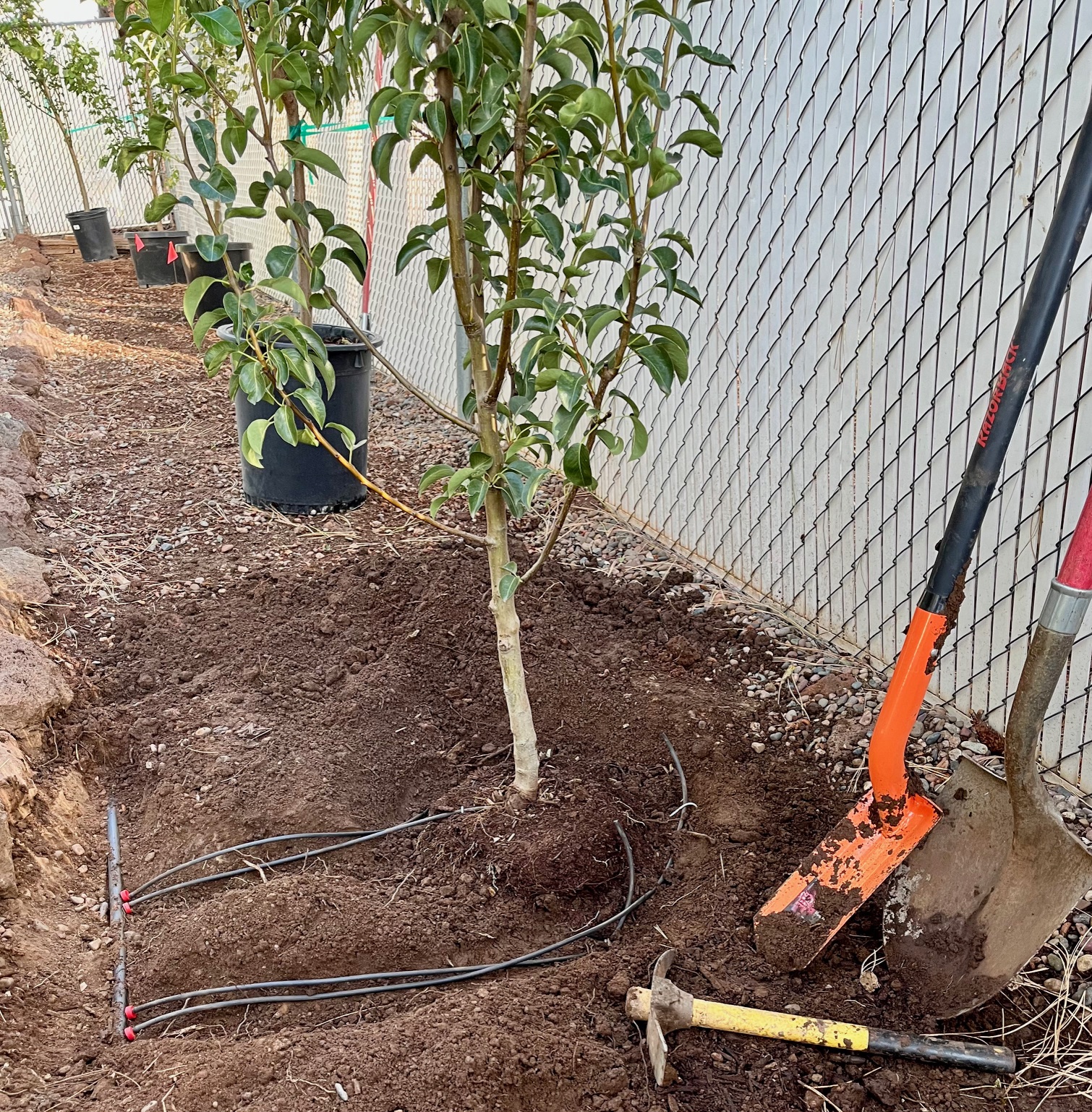
Photo: Installing drip irrigation systems in Flagstaff gardens is essential to preventing drought stress for plants (photo credit Nate O’Meara).
Operating and maintaining drip irrigation systems is not the most exciting aspect of Flagstaff gardening. However, their use is essential in keeping your garden flourishing, especially in a scant monsoon season like we are having this year. In fact, the number one reason for most plant problems in Flagstaff is related to water.
Let’s imagine for a moment that you are a plant living in a garden without an irrigation system. As you start to wake up in March/April with new growth, you are watered by snow melt through April and perhaps a little into May (as long as it has been a good snow year). However, as you really get growing with the warm days of May and June the snow melt in the soil quickly evaporates leaving not enough moisture to sustain your spring flush of growth. Once the hot and windy days of June set in without supplemental irrigation, you wilt, stress, and may perish.
If you live into July, then in a normal monsoon season you will receive enough water to survive; however, the spring stress may mean you didn’t flower or set fruit, experienced stem dieback, and/or dropped a portion of your leaves. But, in years like this when the rains have been so few, you continue to experience drought stress and now have a high chance of not surviving at all. Even in a good monsoon year, you still need consistent water in order to sustain growth, flowering and/or seed production in the warm fall days, yet, since the monsoons typically end by early September, you are once again experiencing drought stress.
Okay, you can stop pretending to be a plant, but hopefully you see why a drip system is critically needed to grow a successful Flagstaff garden. Let’s look a little closer at why and I’ll provide you with some pointers for watering.
Drip irrigation is an effective way of conserving water in our high desert home if the system is properly programmed. Drip systems are designed to deliver a slow application of water directly to the plant’s root zone. This allows us to do two things: water deeply and less frequently. As a result, drought stress is reduced because roots are trained to grow deeper into moist and cool soil. We accomplish this by using low flow emitters close to the ground instead of high output sprinklers, where more water is lost due to evaporation. Commonly, emitters release water in amounts of gallons per hour. Often times, gardeners do not run their system long enough to achieve a deep watering. For example, if you have a 1 gallon per hour emitter and you run the system for twenty minutes; the plant received less than a milk carton of water! Therefore, the system needs to be run for several hours to provide an adequate drink. A handy way to check to see how deep you watered is to take a metal stake and drive it into the wet soil. The stake will stop when it hits dry dirt. Pull the stake up and measure the depth. As a guideline, small perennials should be watered to a depth of one foot, shrubs to two feet, and trees to three feet. As your plants mature, keep in mind that root systems can be one and a half to three times wider than the canopy so emitters need to be added and the drip zone enlarged over time.
In terms of watering frequency, the determining factors are primarily weather and soil types. As humidity and rain decrease and sun, wind, and temperatures increase, you have to irrigate more often. At the same time, plants growing in a sandy fast draining soil require more regular watering compared to a soil that contains more silt or clay that holds moisture longer. In the end, remember that good watering involves observing your plants and adjusting your system to their needs, your soil type, and seasonal changes.
Nate O’Meara is the Executive Director of The Arboretum at Flagstaff.