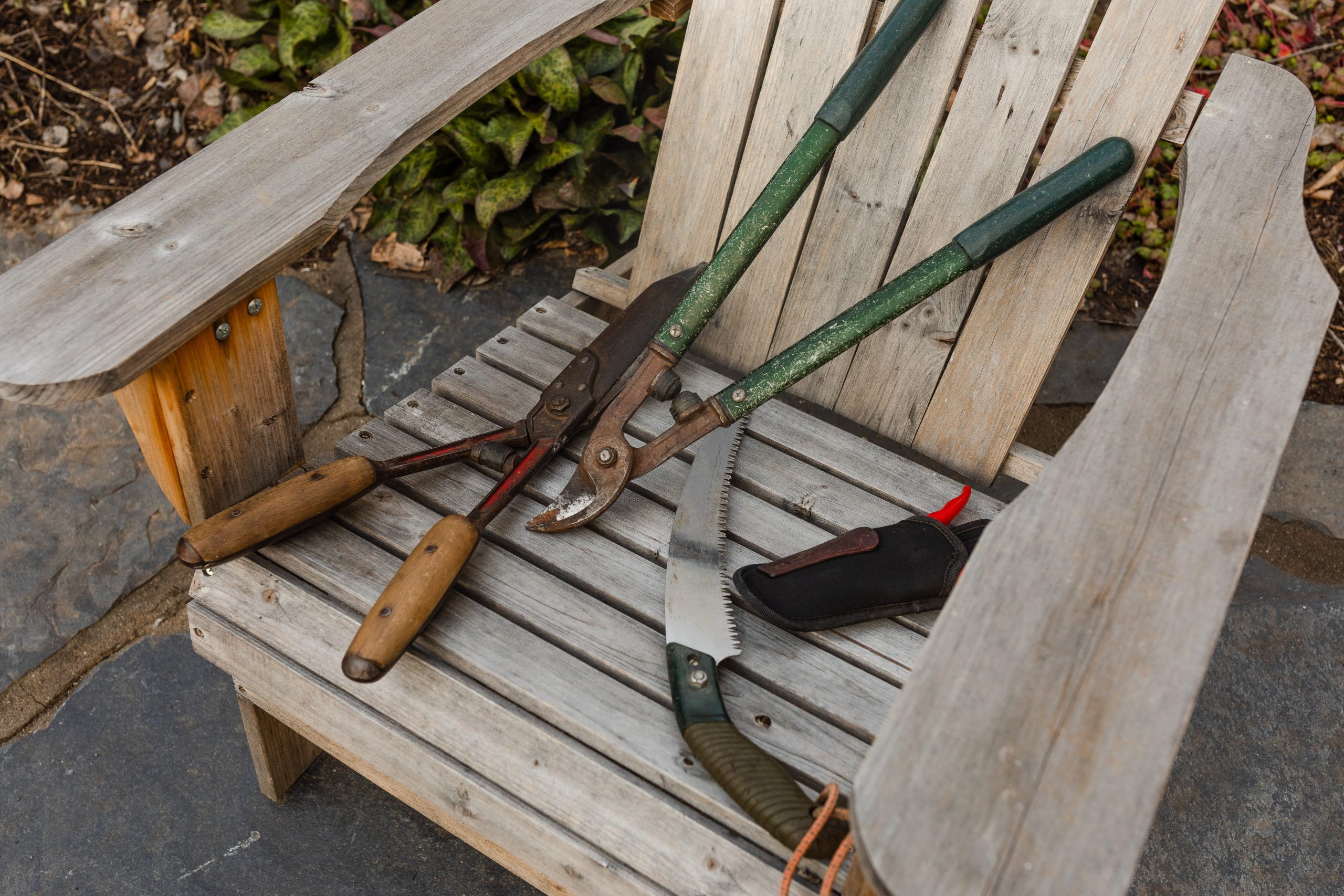
When you are ready to prune, gather the correct tools including a sharp pair of loppers, hand pruners and a good tree saw for larger stems. Safety glasses and gloves will also come in handy. (photo credit: April O’Meara)
This article appeared in the February 5th Arizona Daily Sun.
With snow on the ground and frigid temperatures, it is hard to believe that there is an important garden task that can occur this time of year – renewal pruning your deciduous shrubs!
Compared to an evergreen shrub such as a boxwood or Oregon grape that keep their leaves year-round, deciduous shrubs are those that drop their leaves in the winter, such as a dogwood or spirea. Deciduous shrubs can be pruned during winter dormancy when sap levels are low, and you can clearly see the branching structure. For Flagstaff, this will be in the months of January, February or early March at the latest. The reason we prune our leafless shrubs this time of year is to remove damaged or diseased branches; help maintain the natural size and shape of the plant; and improve flowering, fruiting, and overall vigor.
Before you get started, it is good to keep in mind some basic principles of timing your pruning. A general rule-of-thumb is that shrubs that bear flower buds on the previous year’s growth should be pruned after spring flowering. Forsythia, mockorange and lilac are good examples. Shrubs that bloom on the current year’s wood should be pruned before bud break in spring. Among these are cinquefoil, snowberry and butterfly bush. If you have trouble understanding the concept of old versus new growth, try to imagine the shrubs that bloom in early spring. These are usually old-growth bloomers, as there has been no time during winter dormancy to grow flowering wood. Now think of the shrubs that flower in summer on those warm June-July days. These are new-growth bloomers, as they needed the spring flush of growth to produce new flowering stems and buds.
In addition to timing, it is good to review the four basic pruning techniques used for maintaining shrubs: heading back, shearing, rejuvenation and winter renewal pruning. Heading back is used to control the size of a shrub or to remove a branch that is out of balance with the rest of the plant. It requires that a branch be removed to a good bud or lateral branch. Heading back is best done when new growth is complete, so this kind of pruning usually occurs in mid-to-late summer.
Shearing should only be done when a formal hedge is desired. When shearing, it is important to keep the top of the hedge narrower than the base to allow sunlight to reach the lower branches thus preventing die back. The best time to shear is when new spring growth is complete. Shearing can create added maintenance, as it stimulates growth at multiple growing tips throughout a shrub.
By pruning all stems or canes to ground level, rejuvenation pruning can be used to restore the vigor of old neglected shrubs. Among those that respond well to this treatment are: forsythia, privet, honeysuckle, and spirea. Rejuvenation pruning is best done in late winter or early spring but should only be considered as a last resort, as really old and stressed plants may not grow back after this form of impactful pruning. Also, when rejuvenating a shrub, it could take a season or more for it to flower and fruit again.
The final technique is renewal pruning, which is carried out during the winter dormant season, taking into account the old versus new growth blooming parameters described above. Renewal pruning involves removing select overgrowth so that your shrubs remain vigorous and in the case of flowering ornamentals, better flowering. The basic steps include starting with removing the oldest (thickest) stems. Then, continue to prune out no more than one-third of the stems in a random pattern, starting with any damaged or diseased wood. Now, cut back any remaining branches or stems that look out of place or unwieldy while retaining a natural shape.
As you prune, remember to take frequent breaks to stand back and review what you have accomplished, as you don’t want to get too overzealous. If you are unsure about removing a branch or making a cut, then leave it for another year and observe how it grows next season. The more observations you make, and the more you come to understand how your shrubs respond to pruning, the better pruner you will become. Happy pruning!
Nate O’Meara is the Executive Director of The Arboretum at Flagstaff.