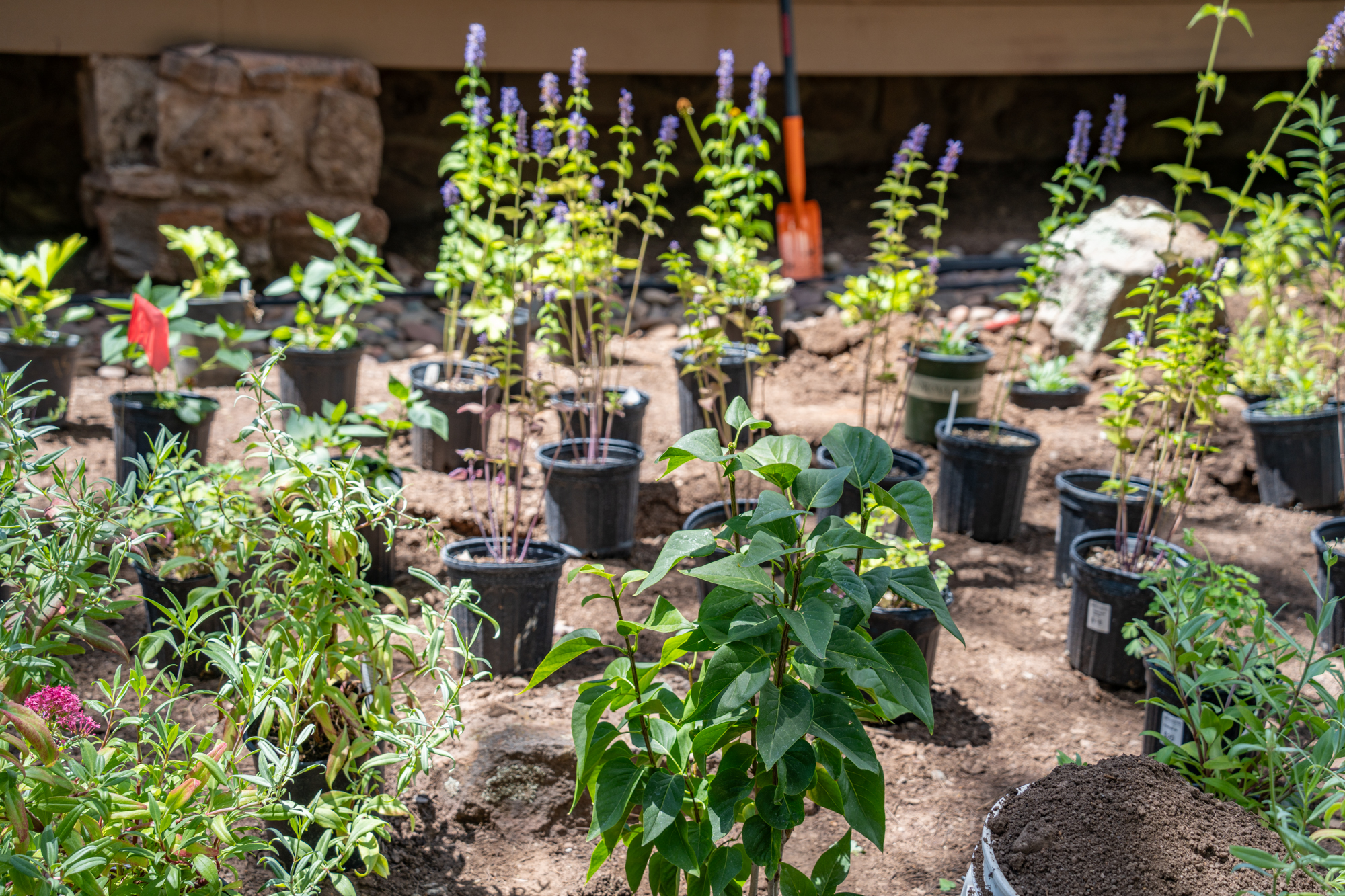
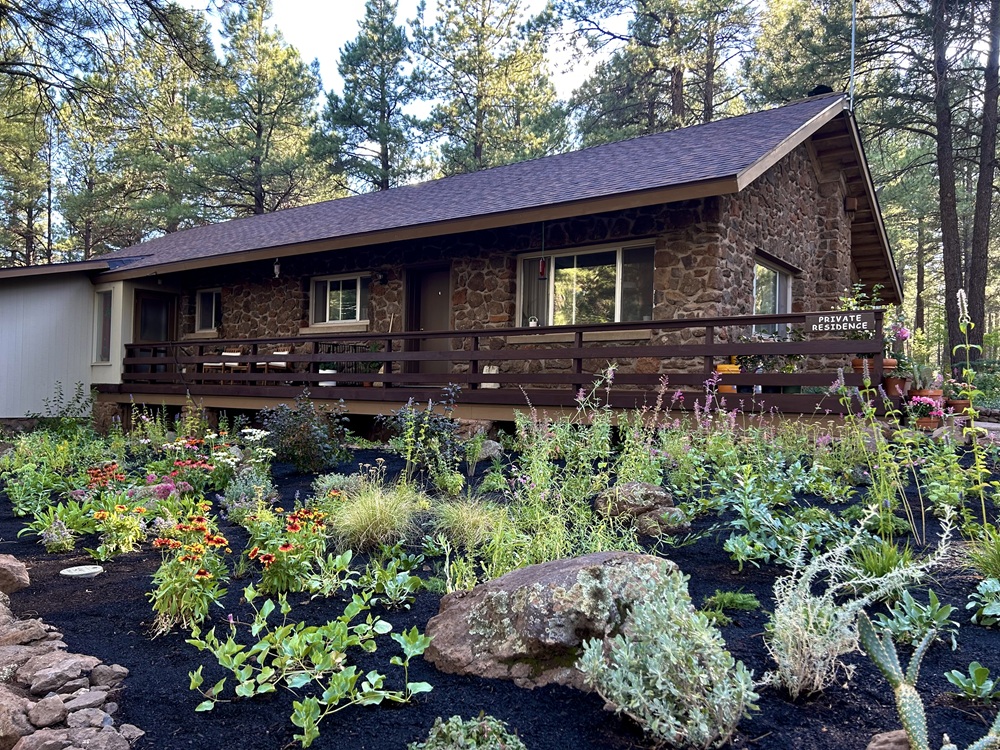
Completed fire- and water-wise garden at The Arb.
In the midst of our busy season last year, Executive Director extraordinaire Nate O’Meara and I teamed up to write a grant offered by one of our favorite local organizations, Creative Flagstaff. Our goal: to receive funding to install a brand new garden at The Arb that would be fire- and water-wise.
The concept behind this new garden was born from a very real and very scary reality. Wildfire in the west has become an unavoidable season and drought is visible throughout the landscape everywhere we look. As a botanical garden in the middle of a thick ponderosa pine forest, we are constantly on our toes regarding fire.
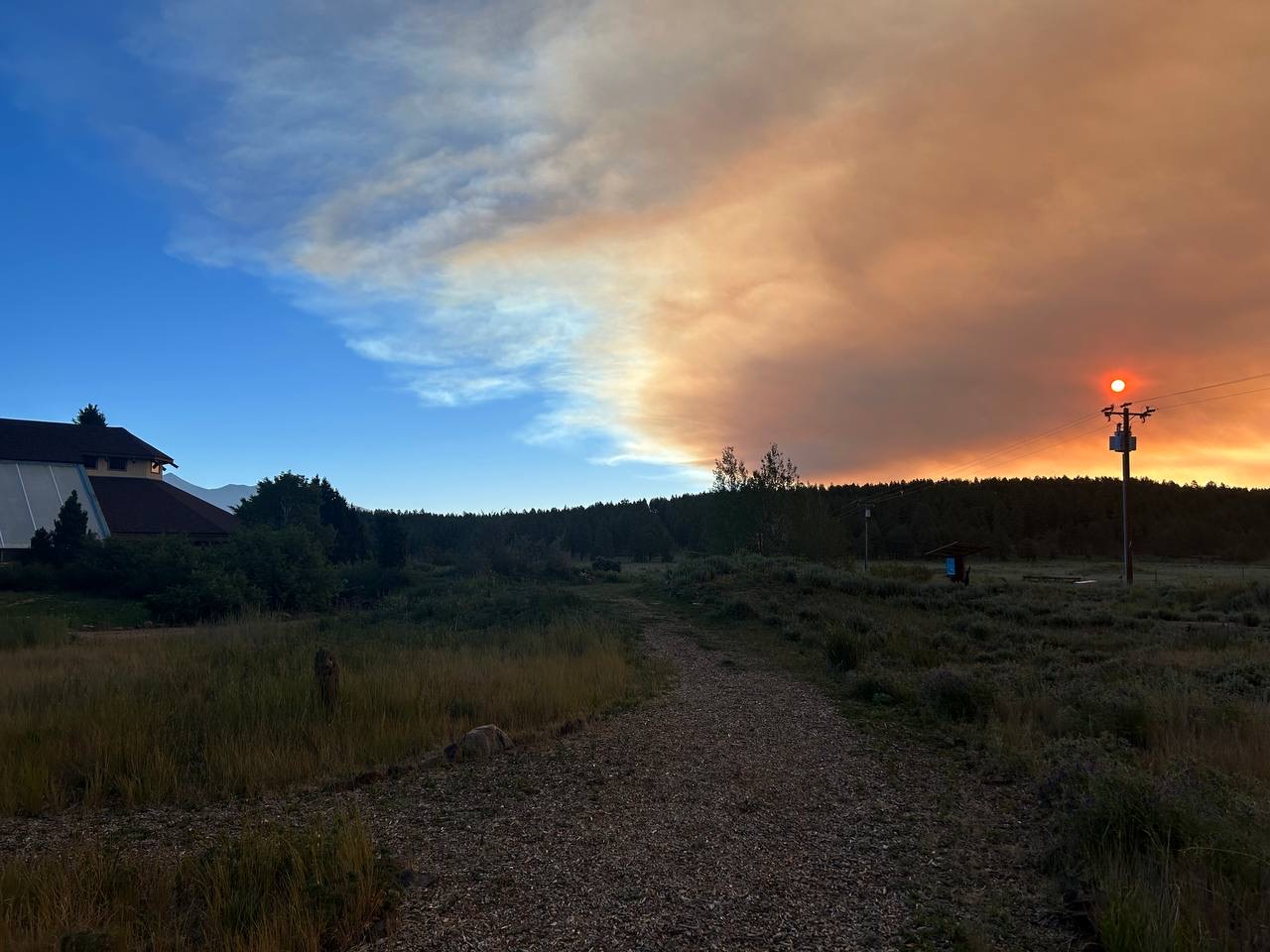
Ironically, amid preparing this new firewise garden, the Pocket Fire broke out. This brought all our programming to a halt as we nervously waited, preparing for the worst while hoping for the best. In the end, that is all you can really do in the face of wildfire.
Our founder, Francis McAllister, was a pioneer in forest thinning. She was doing it before it was the cool thing to do, which has helped tremendously in the health of our surrounding forest. Unfortunately, there is still so much work to be done.
It is not easy work, nor is it inexpensive work. As many Flagstaff homeowners know, the removal of one ponderosa pine can cost upwards of $3,000. On top of that, insurance companies are either skyrocketing prices or dropping homes altogether due to the fire risk.
Between our own organizational struggles and our collective community struggles, we were inspired to install a fire- and water-wise garden to showcase the multitude of plant species that are perfectly suitable to exist near a home and still be considered fire- and water-wise. Most importantly, I want to educate people that you can have a beautiful garden and still be considered firewise! And you don’t have to quadruple your water bill to do it! Put another way: you do not need to strip and gravel your yard!
At this point you may be wondering, what exactly is considered “firewise”? It is a bit of a rabbit hole in itself, and for in depth information, I highly recommend visiting the National Fire Protection Associations website.
While there are many things to consider in applying firewise principles to your home (and trust me, it is easy to become overwhelmed), the key factors I would like to emphasize here are to remove debris (dead leaves and pine needles from the roof and ground), to create a 5-foot “buffer zone” between your home and a potential fire. Additionally, all vents should be 1/8-inch metal screening to keep embers out. Lastly, and this one might seem obvious, keep highly flammable plants and materials at least 5 feet from the home.
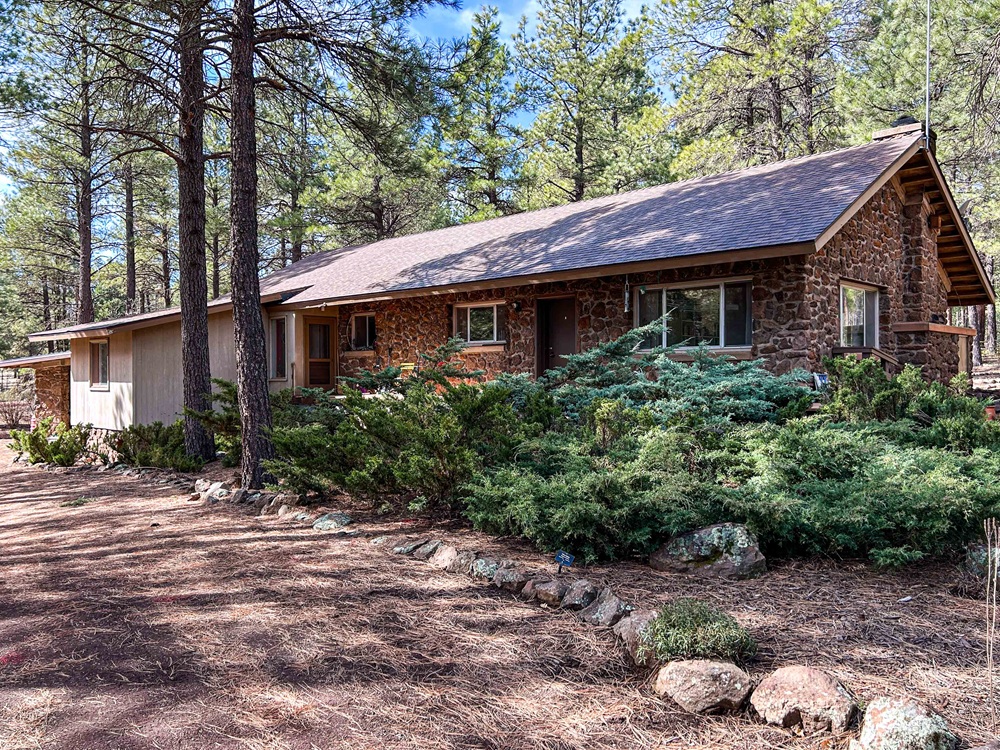
Caretakers Cottage with Chinese Juniper
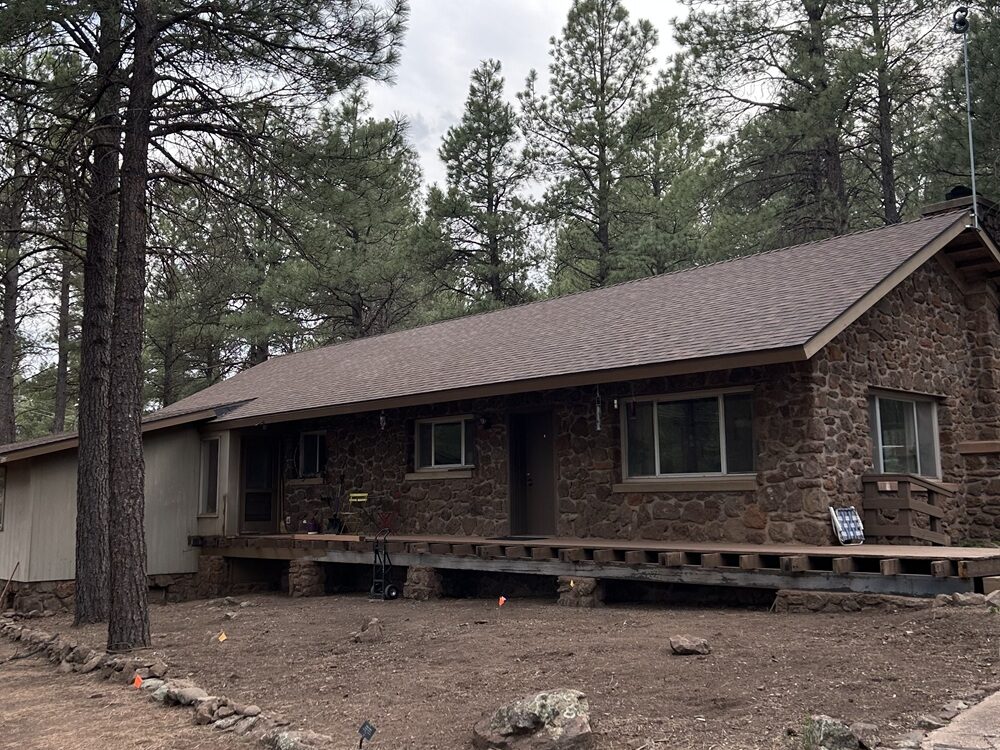
Caretakers Cottage without Chinese Juniper
The starting point of the new fire- and water-wise garden at the Arb was a lovely cottage home with a sea of Chinese Juniper (Juniperus chinensis) occupying the entirety of the unirrigated yard. While this was seemingly the ‘it’ plant of 1970’s Flagstaff due to its low maintenance evergreen presence, this is the one plant the fire professionals we consulted with told us to remove due to its high resin content. Those sticky resins found in many evergreens are precisely what makes a wildfire go from 0 to 100,000 acres in a matter of minutes.
Thus began our journey, beginning with the hard labor of removing all the Juniper from the yard (not to mention a deck restoration!) Shout out to Caretaker and Facilities Manager extraordinaire Colin for those huge efforts!
As Colin was pickaxing Juniper roots, I was dreaming of the garden to come. The key principles considered when selecting plant species were: deciduous, herbaceous, non-resinous species that are drought tolerant. Fortunately, most of my favorite plants fell into these categories and I was able to fulfill all my Penstemon Agastache Columbine dreams! Another win: sticking with mostly native plants made this selection easy. You can find the complete species list below. But before that, let’s discuss drip irrigation.
The majority of the Arboretum’s irrigation is overhead sprinkler style. Up until this point, I thought it was a great way to do it. After all, there are many pros such as: you can see it working or not working, it mimics rain for the plants (but let’s be honest, they know the difference) and it can be easier to install versus dripline in the sense that you can cover more ground with fewer irrigation parts. I’m not going to lie, while installing the hundreds of emitters and lines this garden required, I was pretty upset we didn’t just do an overhead system. It is a ton of labor up front as each plant needs their own drip line. But I am here to tell you: it is worth it!
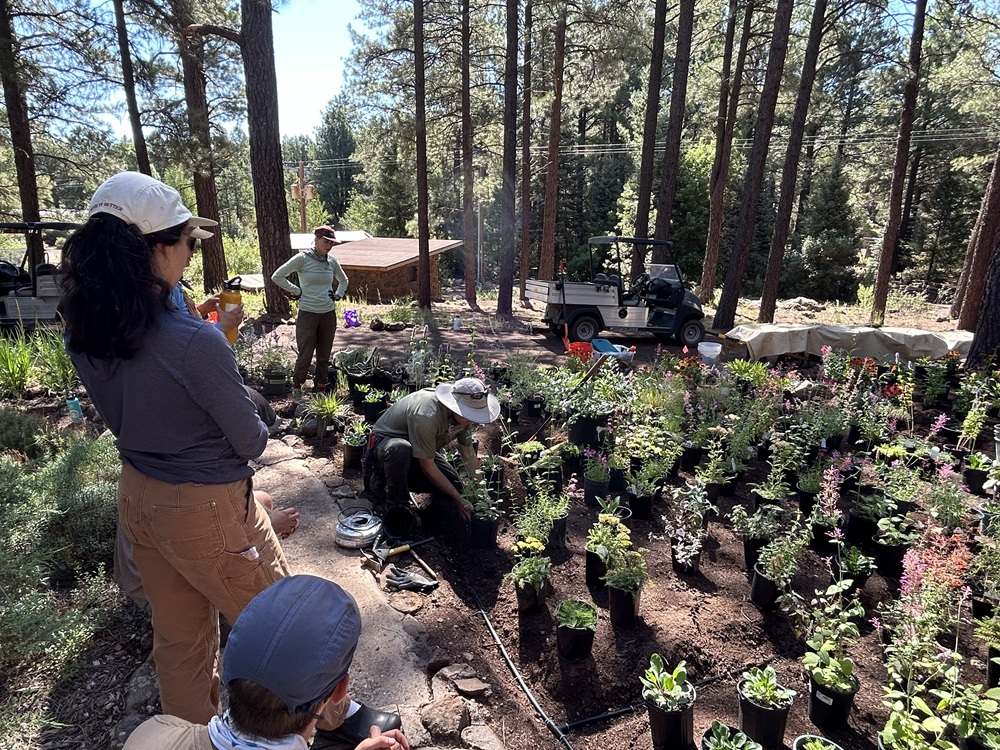
The crew learning the ways of drip line from our fearless leader, Nate
The garden has been completed for one month and the growth rate I have seen is significantly higher than any overhead or hand watered plant I have ever planted. While sitting on the porch pondering this phenomenon, I realize how valuable a slow drip of water is for a plant vs. a blast of hose water.
Even if you are taking your time and giving the plant plenty of water, the fast rate at which it is pouring out of the hose matched with the hydrophobic soil we have – the soil simply can’t absorb the water – leaves your water bill high and your plants still thirsty. This leads to slower growth and shallow roots systems that lead to perpetually thirsty plants. Needless to say, this garden installation has led me to be a believer in drip irrigation.
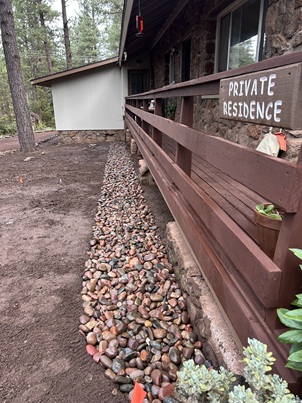
Another waterwise feature of this garden is the passive water collection we installed via trenching and filling with river rock. Not only does this double as our firewise defensible space buffer zone between the house and the garden, but it also absorbs and slows the roof run off and distributes into the garden.
Once the plants were in the ground and the irrigation was completed, we toped the garden off with compost from Restoration Soils. That final layer really makes the plants pop, not only because it is a nice dark color but because the plants love those nutrients!
I hope this article has inspired you pick up some pine needles, rip out some Junipers and replace them with drought tolerant, native perennials! Keep an eye out for upcoming educational events regarding Fire and Water Wise practices throughout this season and next and if you have any questions, you can contact me at gina.goegan@thearb.org
Below you will find the full list of species planted. We sourced all of these plants from Warners, Violas, Verde River Growers, Lily of the Field, and our very own greenhouses.
Gina Goegan is the Greenhouse Manager at The Arboretum
FIRE-WISE AND WATER-WISE PLANT LIST
N=Native; NN=Non-Native
Achillea sp., Yarrow in a variety of colors (N)
Agastache ‘Coronado Red’, Hummingbird Mint (NN)
Agastache ‘Morello’, Hummingbird Mint (NN)
Agastache ‘Double Bubble’, Hummingbird Mint (NN)
Agastache ‘Sunset Hyssop’, Hummingbird Mint (NN)
Agastache cana, Texas Hummingbird Mint (NN)
Agastache rugosa, Licorice mint (NN)
Amelanchier x Grandiflora ‘Autumn Brilliance’, Service Berry (NN)
Antennaria dioica ‘Rubra’, Pussytoes (N)
Aquilegia sp., Arboretum Hybrid Columbine (N)
Arctostaphylos uva ursi ‘Massachusetts’, Kinnickinnick (N)
Bouteloua gracilis ‘Blonde Ambition’, Blue Grama Grass (N)
Bouteloua gracilis, Blue Grama Grass (N)
Calamagrostis x acutiflora ‘Karl Foerster‘, Karl Foerster Grass (NN)
Centranthus ruber, Red Valerian (NN)
Physocarpus opulifolius, Diabolo Ninebark (NN)
Coreopsis lanceolata, Lance Leaf Coreopsis (NN)
Delphinium geraniifolium, Mogollon larkspur (N)
Digitalis ‘Dalmatian Peach’, Peach Foxglove (NN)
Digitalis lanata, Straw Foxglove (NN)
Digitalis purpurea, Purple Foxglove (NN)
Echinacea ‘Pow Wow White’, Coneflower (NN)
Echinacea ‘Red Ombre’, Coneflower (NN)
Echinacea purpurea, Purple Coneflower (NN)
Echinacea ‘Saffron’, Coneflower (NN)
Fallugia paradoxa, Apache Plume (N)
Gaillardia aristata ‘Arizona Sun’, Blanketflower (N)
Geranium caespitosum, Pineywood Geranium (N)
Geranium sanguineum ‘Vision Violet’, Blood Geranium (NN)
Iris ‘My Friend Jonathan’, Bearded Iris (NN)
Iris ‘Wine Fesitival’, Bearded Iris (NN)
Iris sibirica ‘Peacock Charming Billy’, Siberian Iris (NN)
Iris germanica ‘Batik’, Bearded Iris (NN)
Iris germanica ‘Neptunes Wine’, Bearded Iris (NN)
Krascheninnikovia lanata, Winterfat (N)
Lavandula angustifolia, English Munstead Lavender (NN)
Leucanthemum x superbum, Shasta Daisy (NN)
Lupinus perennis, Wild Lupine (NN)
Mahonia aquifolium, Oregon Grape (NN)
Mirabilis longiflora, Sweet Four O’Clock (N)
Mirabilis multiflora, Colorado Four O’Clock (N)
Monardella odoratissima, Coyote Mint (N)
Nepeta ‘Cats Pajamas’, Catmint (NN)
Nepeta ‘Six Hills Giant’, Catmint (NN)
Opuntia sp., Prickly pear (N)
Paxistima myrsinites, Oregon Box Leaf (N)
Penstemon barbatus, Scarlet Bugler (N)
Penstemon cardinalis, Cardinal Penstemon (N)
Penstemon eatonii, Firecracker Penstemon (N)
Penstemon mexicali, Pikes Peak Penstemon (N)
Penstemon palmeri, Scented Penstemon (N)
Penstemon strictus, Rocky Mountain Penstemon (N)
Penstemon whippleanus, Whipple’s Penstemon (N)
Perovskia atriplicifolia, Russian Sage (NN)
Prunus pumila, Western Sand Cherry (N)
Rosa ‘Cecile Brunner’, Sweetheart Rose (NN)
Rosa ‘State of Grace’, Grandiflora Rose (NN)
Rosa rugosa ‘Seaside Swirl’, Rugosa Rose (NN)
Rosa woodsii, Wood’s Rose (N)
Rudbeckia fulgida, Orange Coneflower (NN)
Machaeranthera bigelovii, Tansyaster (N)
Salvia pachyphylla, Mountain Desert Sage, (N)
Sambucus canadensis ‘Adams’, Elderberry (N)
Sambucus nigra, Elderberry (N)
Sedum ‘Autumn Joy’, Stonecrop (NN)
Sedum ‘Vera Jameson’, Stonecrop (NN)
Solidago multiradiata, Rocky Mountain Goldenrod (N)
Solidago canadensis, Canada Goldenrod (N)
Rudbeckia laciniata, Cut Leaf Coneflower (N)
Syringa vulgaris ‘Monge’, Lilac (NN)
Veronica peduncularis, Creeping Speedwell (NN)