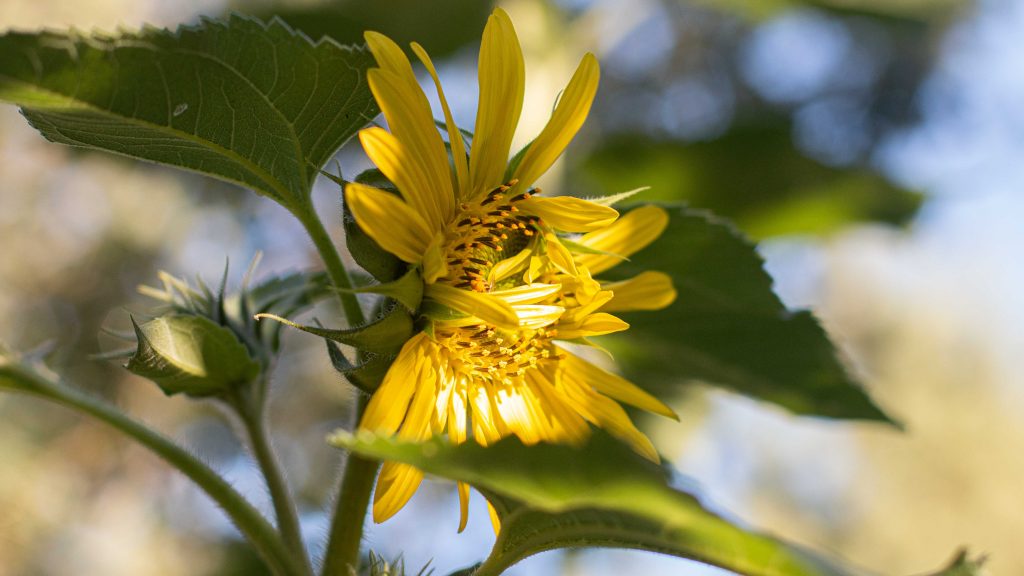
Sunflowers grow and track the sun through a process called heliotropism (photo credit: April O’Meara)
This article first appeared in the June 18th Arizona Daily Sun.
In the cool darkness of a recent summer morning, I stared in wonder at the bright faces looking back at me. My young sunflowers (Helianthus annuus) in the grove were standing like soldiers waiting to salute the rising sun. During the previous day, their leaves and flowers tracked the sun as it made its daily voyage from east to west across the sky. And now under the cover of nightfall, they rotated their stems back to greet the sun again.
This remarkable ability of sunflowers to track the sun’s movement is called heliotropism. New botanical research on the subject has found that solar tracking is caused by different sides of the plant’s stem elongating at alternate rates throughout the day and night. In order to track the sun’s movements during the day, the growth rates on the east side of the stem are higher while the increased growth rates at night on west side allow sunflower stocks to turn and greet the dawn. This daily elongation maximizes growth and is why sunflowers planted from tiny seeds in spring can reach over 10’ tall by summer’s end! Once the plants mature, sunflowers will predominantly face east so that the warming sun will heat the flowers which is thought to better attract pollinators.
As sunflowers grow and mature, a whole community of organisms emerges high above the ground. Take a moment each day to observe all the lives that unfold on sunflowers. Turn over the leaves and you will discover multiple species of aphids, ants, and lady bugs. Peer into the crevices of the flowers and you will happen upon goldenrod crab spiders. These fascinating creatures camouflage themselves by changing their body color to yellow or white depending on the species of plants they are living on! Once disguised among the pedals they prey upon unsuspecting bees or wasps. At the same time, daddy long leg spiders and earwigs seem to wait patiently to feed on insects and plant juices while leaf miners make iridescent tunnels through sunflower leaves. As the flowers open, honey bees comb the pollen laden florets gathering the golden powder on their hind legs before journeying home to their hive.
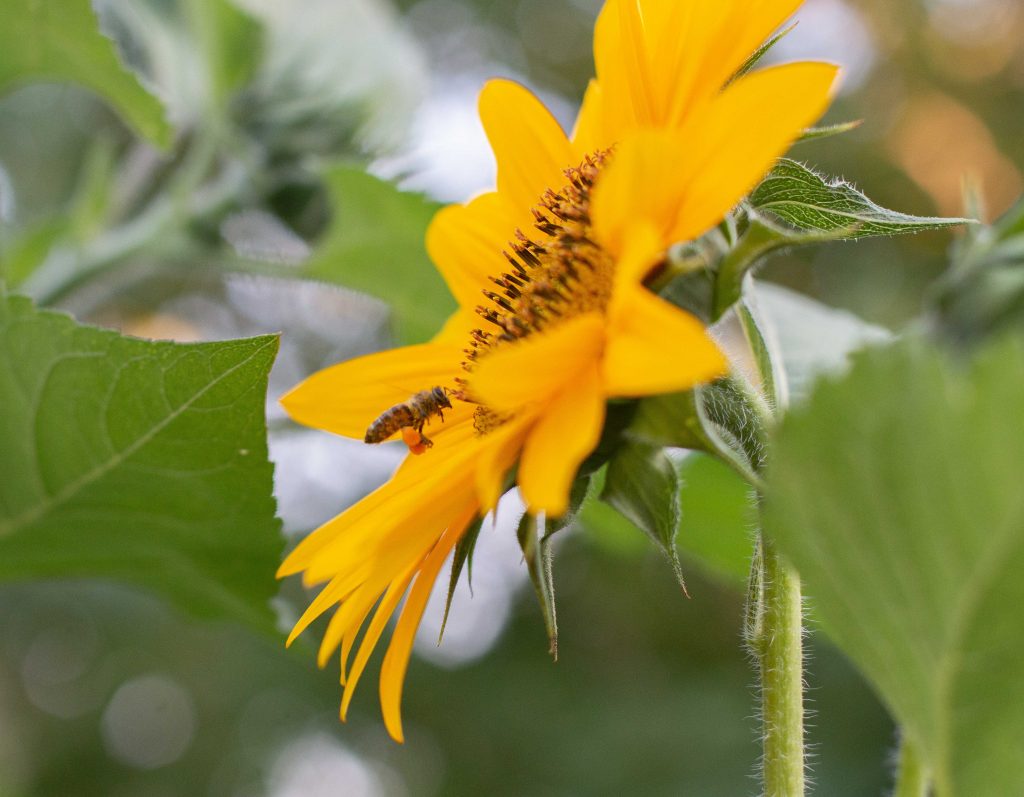
A honey bee visiting a sunflower with pollen on its legs is a true wonder to watch (photo credit: April O’Meara)
In autumn, as sunflower seeds ripen and their leaves brown along the stem, the heavy flower heads droop looking to the ground as if deciding where to plant their seeds to start the cycle again next year. The drooping, though, is no match for the most agile song birds like goldfinches, house sparrows, and warblers who pick away at nature’s most natural bird feeders.
In order to bring these wonders of the sunflower to your garden, they should be planted from seed in spring. Sunflowers thrive in sunny locations, in almost any garden soil but need regular water to achieve a good bloom. Try planting them intentionally to the back of a flower bed or vegetable garden in order to provide shade to smaller and more heat intolerant plants later in the season.
In terms of varieties to try, here are some of my favorite heirlooms whose stories and characteristics add to the wonder of sunflowers. ‘Irish Eyes’ is good for containers as it produces dwarf plants loaded with multiple blooms that have pointed golden petals and green centers. ‘Lemon Queen’ grows 10 feet tall with large lemon-yellow petals and dark chocolate centers. ‘Teddy Bear’ has double golden-yellow flowers on dwarf plants that only grow 18-24 inches making them a favorite for children. ‘Tarahumara White Seeded’ is well-adapted to a variety of conditions. The Tarahumara people of Mexico grow them for their edible ivory-colored seeds. ‘Hopi Black Dye’ is traditionally grown for the blue/black seed hull to make a wool and basket dye. For something different, try ‘Autumn Beauty’ for its dark burgundy to bicolor flowers. All these varieties can be purchased from nonprofits dedicated to preserving heirloom seeds including Seed Savers Exchange (www.seedsavers.org/) and Tucson, Arizona based Native Seed SEARCH (www.nativeseeds.org). Happy sunflower gardening!
Nate O’Meara is the Executive Director of The Arboretum at Flagstaff.