
Hopefully we’re all still enjoying our migrators as they pass through on their way to warmer destinations in preparation for a (fingers-crossed) snowy winter. Here, we will take a look at a few species of birds in the Corvidae family, which you can enjoy year-round in Northern Arizona. Birds in the Corvidae family have a few characteristics in common: medium to large in size, strong feet for perching, thick and slightly curved bills, rictal bristles (or stiff, hair-like feathers) that cover the base of their beaks and nostrils, and their high intelligence.
Crows and Ravens
“What’s the difference between a crow and a raven?”
I’ve spent almost a decade volunteering and working with wildlife and that’s enough time to be asked this question about a million times. And it’s always one I love answering!
First off, if you see a black bird and find yourself thinking, “Man, that is a HUGE crow!” then it’s probably a raven. Crows are quite a bit smaller, but that isn’t always easy to see unless you’re looking at them side-by-side, right? So let’s go over a few other identifying characteristics.
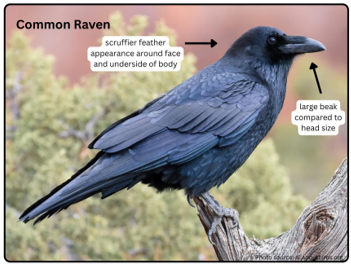
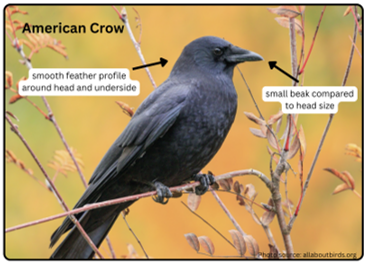
Looking at them on the ground or perched in a tree, look for these features:
- Ravens: large beak compared to head size, scruffier feather appearance around the face and underside of its body, larger body size overall
- Crows: small beak compared to head size, smoother feather appearance overall, smaller body size
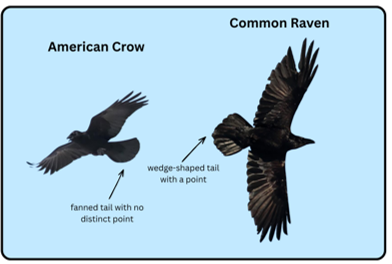
If the bird is in flight and seeing those finer details is difficult, tail shape is a great identifier. Ravens have a wedge or diamond shape to their tail, with a defined point at the end. The profile of a crow’s tail will be much smoother, like a rounded fan.
Still not sure what you’re seeing? Look at behavior! More often than not, crows travel in large, noisy flocks (or murders). Ravens will often fly in pairs or in threes (usually parents and their offspring). Fun Fact: Juvenile crows and ravens have fleshy, pink inside their mouths whilst adults have gray or black.
Woodhouse’s Scrub-Jay
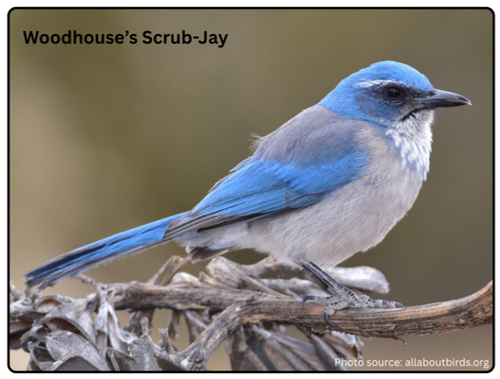
These jays can be found in pinyon-juniper woodlands in Northern Arizona. They are a dusty blue (some may appear bluer than others) with a whitish chin and neck. They also have a brownish gray back patch, gray belly, gray cheek, and a notable white “eyebrow”. Their tails are fairly long, giving them that classic “jay” look. These jays will typically show up in pairs to enjoy a feast of pinyon pine nuts. Occasionally, they will also hang around mule deer as they pluck and eat ticks and other parasites off its body.
Pinyon Jay
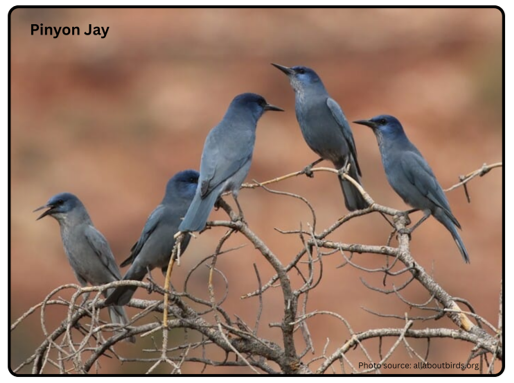
As the name suggests, these jays can be found where pinyon pines are plentiful. Because they inhabit similar habitat, these jays may often be confused with the Woodhouse’s Scrub-Jay. Pinyon Jays are mostly a dull gray-blue all over their body, with a more or less prominent gray-white chin and long black beak that comes to a sharp point. They lack the white eyebrow of the scrub jays and their tails are shorter than the tails of most other jay species, comparative to their body size. Additionally, these birds fly in large, loud, noisy flocks. Although these birds tend to stay within those lower elevation pinyon-juniper woodlands, we did see a flock fly over The Arb a few weeks ago and have heard reports of appearances in the city of Flagstaff as well!
These birds do not migrate, but can be considered “nomadic” in the sense that their flocks will travel across large areas in search of food – mainly pinyon pine nuts/seeds. They have the ability to store up to 40 seeds in their expandable esophagus as they fly from tree to tree before eventually making a stop at their caching site, where they will store seeds by the thousands for the upcoming winter. That said, pinyon jays are also considered an “irruptive” species – meaning that even though they are permanent residents of their range, in years when cone crops fail and food is scarce, they will often leave in search of food elsewhere.
Steller’s Jay
I know I’ve mentioned these jays before, but I felt it necessary to include them here as they are plentiful in and around Flagstaff all year long. And who couldn’t love that spunky black mohawk and brilliant blue plumage? It’s easy to spot these birds in the tall branches of our ponderosas, but they also spend a good amount of time foraging on the ground. These birds love to mimic all sorts of sounds. I mentioned in a previous article that one of our resident jays learned an impressive red-tailed hawk call (that he’s still practicing and perfecting constantly). But he has now added osprey calls to his resume! So if you’re around the Visitor Center this fall and you think you hear a bird of prey…it’s likely you’re just hearing this little dude.
But you never know! So keep your eyes peeled, binoculars handy, and as always…happy birding!
Sylvia Coppers is The Arb’s Naturalist & Visitor Services Manager